|
|
Part of “What is sanctity?”
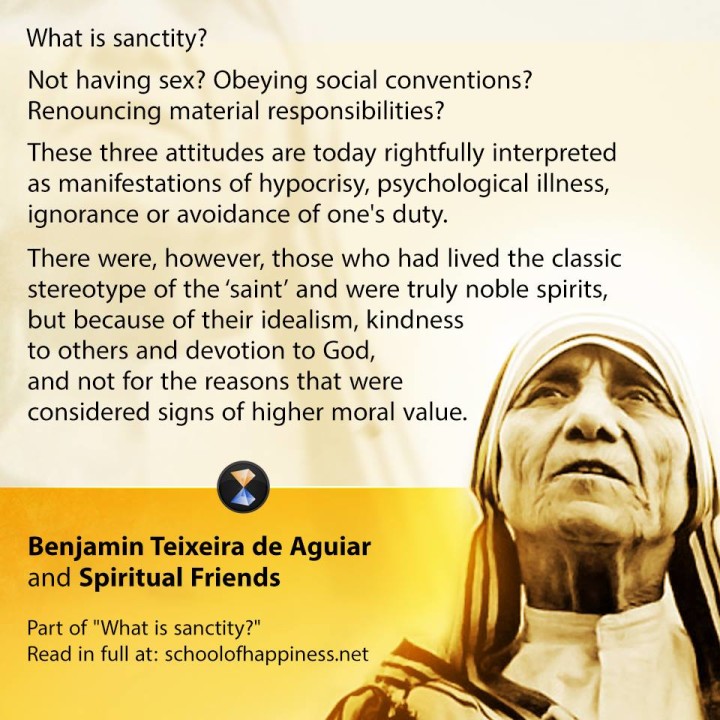
Not having sex? Obeying social conventions? Renouncing material responsibilities?
These three attitudes are today rightfully interpreted as manifestations of hypocrisy, psychological illness, ignorance or avoidance of one’s duty.
There were, however, those who have lived the classic stereotype of the ‘saint’ and were a truly noble spirits, but because of their idealism, kindness to others and devotion to God, and not for the reasons that were considered signs of higher moral value.
Benjamin Teixeira de Aguiar by the Spiritual Friends.

Not having sex? Obeying social conventions? Renouncing material responsibilities?
These three approaches are today rightfully interpreted as manifestations of hypocrisy, psychological illness, ignorance or avoidance of one’s duty.
There have been, however, those who have lived the classic stereotype of the ‘saint’ and were a truly noble spirits, but because of their idealism, kindness to others and devotion to God, and not for the reasons that were considered signs of higher moral value.
Currently, enlightened men and women do not yearn for ‘sanctity’, they seek to be mature and fair, in the fulfilment of duties they perceive as their responsibility, not by delegation of today’s morals and legislation, but as an assignment of their own consciousness, which often, as we know, can contradict what the law or customs, of a time and place, dictate as right.
Saint Francis of Assisi, for example, took off his clothes in public, in the “shocking” circumstance of rejecting his biological father, during a lawsuit filed by the latter, who accused him of stealing his material possessions.
Benjamin Teixeira de Aguiar and Spiritual Friends.
July 31, 2014.
Part of “Assembly about dealing with the primitive in oneself”
Your expressions of primitivism will be forgiven, to the extent that you compensate yourself, before the Laws of Life, by doing good to an even greater extent. Do not waste time blaming yourself: focus on working toward the extension of good to others. Who knows if it was even to give to you a greater stimulus to accomplish the best that Divine Goodness has permitted you the experience of error?
Benjamin Teixeira de Aguiar by the Spirit Eustáquio.
Read in full: “Assembly about dealing with the primitive in oneself”
Part of “Personal choice of happiness.”

You try to be Christian and it sounds difficult to forgive what you consider serious flaws, of people who share your intimacy?
But if Jesus asked us to forgive our enemies, loving them as we love ourselves, what doesn’t He expect us to do with respect to our friends? The very Christ of Truth answers us, categorically asserting that the true friend is the one who gives his life for his friends — and He Himself proved this to us, with His example.
Benjamin Teixeira de Aguiar by the Spirit Eugênia-Aspásia.
Read in full: “Personal choice of happiness”
Part of “Personal choice for happiness.”
Do you remember unhappy occasions, tremendous failures of the past, downfalls or negligence for which you would hardly forgive yourself?
Why not understand that instead of being a victim of external or internal factors, the correct and best course of action, from all angles of observation, is to opt to perceive yourself as a winner over unfortunate circumstances, making it worthy, before your own consciousness, the image of someone who has acted with heroism, rather than someone deserving the title of victim of the injustice from others or even taking on the role of your own tormentor?
Benjamin Teixeira de Aguiar by the Spirit Eugênia-Aspásia.
Read in full: “Personal choice of happiness”
|
|
